
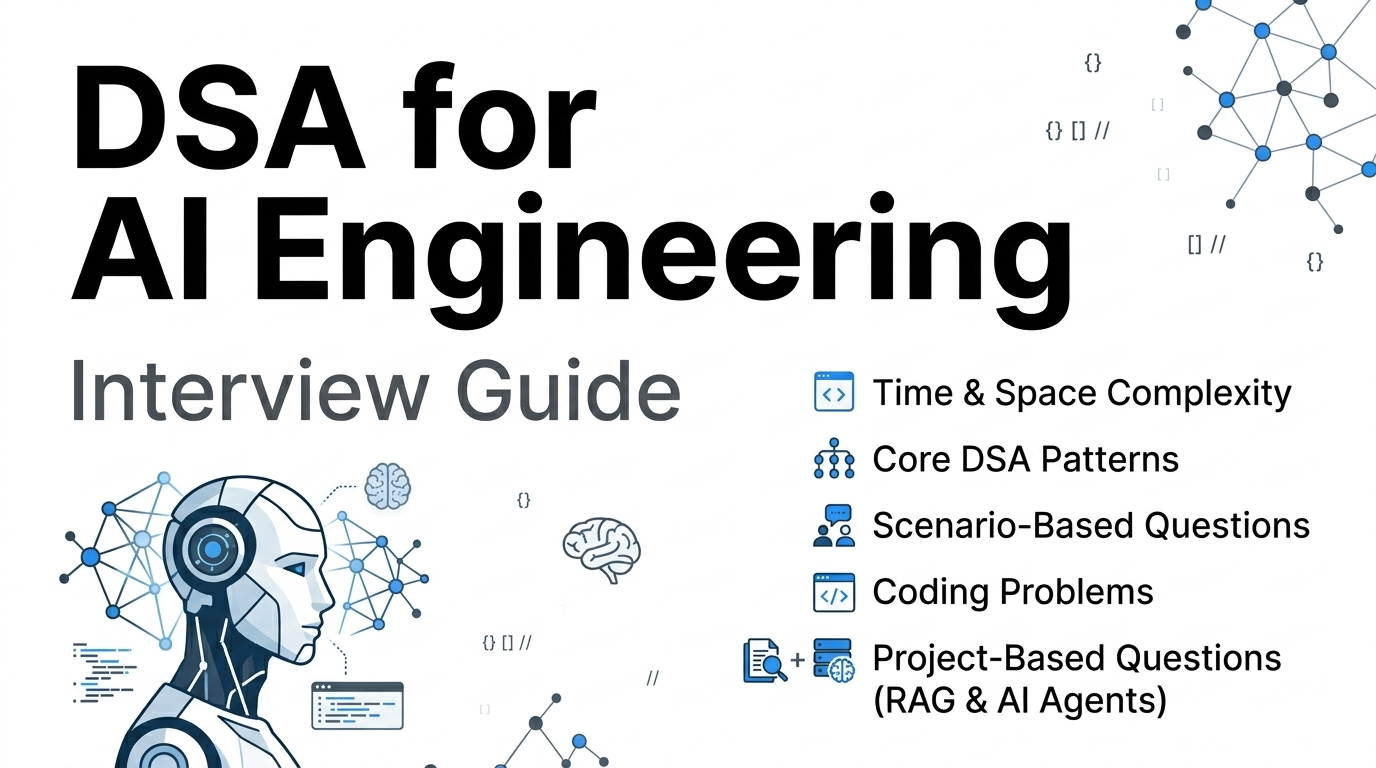
DSA for AI Engineers
- 5 Sections
- 32 Lessons
Time & Space Complexity
Core DSA Questions
Scenario-Based DSA Questions
Coding Problems
AI Project-Based DSA Questions (Agents & RAG)
DSA for AI Engineering (Interview Guide)
Breaking into AI and ML engineering roles often requires more than knowing models and frameworks. Many companies still evaluate candidates on problem-solving ability, algorithmic thinking, and data structure fundamentals during the first technical rounds.
This guide is designed to bridge that gap.
Instead of teaching generic computer science theory, this interview guide focuses on the DSA patterns that actually appear in AI/ML engineering interviews and real AI systems. The goal is to help you build strong problem-solving intuition and confidently clear the coding and technical screening rounds.
Throughout this guide, you will work through carefully selected questions that emphasize thinking, reasoning, and practical application, rather than memorizing solutions.
Who This Guide Is For
This guide is designed for:
-
AI Engineers
-
Machine Learning Engineers
-
Data Scientists transitioning into ML/AI roles
-
Students preparing for AI/ML technical interviews
-
Software engineers moving into Generative AI or ML systems
If you're preparing for technical interviews that include coding, algorithmic thinking, or system reasoning, this guide will help you build the right foundation.
What This Guide Covers
The guide is structured to progressively build your understanding of the most important DSA patterns used in interviews and real-world systems.
You will work through 150 carefully designed questions across multiple sections:
1. Time and Space Complexity
Before solving problems, you will learn how to analyze algorithm efficiency and reason about trade-offs between performance and memory usage.
2. Core Data Structure and Algorithm Patterns
You will practice the most important patterns used in interviews, including:
-
Two Pointers
-
Sliding Window
-
Hash Maps and Sets
-
Prefix and Suffix Sums
-
Binary Search
-
Stacks
-
Heaps and Priority Queues
These patterns appear frequently in coding interviews and are widely used in real engineering systems.
3. Scenario-Based Problem Solving
You will work through real-world scenarios that test your ability to choose the right algorithmic approach rather than just writing code.
4. Coding Problems
You will practice 40 common coding problems that frequently appear in technical interviews for AI/ML engineering roles.
These problems help strengthen your ability to implement efficient solutions under interview conditions.
5. AI Project-Based Questions
Finally, the guide connects DSA concepts with real AI system design, including:
-
Retrieval-Augmented Generation (RAG) pipelines
-
Agent memory and context management
-
Document retrieval and ranking
-
Dataset preprocessing pipelines
-
Embedding deduplication and caching
This section helps you understand how data structures and algorithms are used in real AI engineering workflows.
How This Guide Helps in Interviews
By completing this guide, you will be able to:
-
Recognize common algorithmic patterns quickly
-
Approach coding problems with structured thinking
-
Analyze time and space complexity confidently
-
Apply DSA concepts to real AI engineering scenarios
-
Perform better in coding rounds and technical interviews
The objective is simple:
Help you build the problem-solving mindset required to succeed in AI and ML engineering interviews.
Want to submit a review? Login